Rapid Fire Session
.jpg "Felicia Seemann, PhD photo")
Felicia Seemann, PhD
Assistant Professor
Karolinska Institutet
Bethesda, Maryland, United States
Felicia Seemann, PhD
Assistant Professor
Karolinska Institutet
Bethesda, Maryland, United States
Rajiv Ramasawmy, PhD
Staff Scientist
National Heart, Lung, and Blood Institute, National Institutes of Health
Bethesda, Maryland, United States

Ahsan Javed, PhD
Staff Scientist
National Heart, Lung, and Blood Institute, National Institutes of Health
Vienna, Virginia, United States
Anastasia Tsakirellis
Nurse Practitioner
National Institutes of Health, United States
.jpg "Jordan C. Taylor photo")
Jordan C. Taylor
MRI Technologist
NIH
Laurel, Maryland, United States

Adrienne E E. Campbell-Washburn, PhD
Principal Investigator
National Heart, Lung, and Blood Institute, National Institutes of Health
Bethesda, Maryland, United States
| Rest | Exercise 1st PIPER | Exercise 2nd PIPER | Exercise CardioStep | |
| Percent max heart rate by age (%) | 38±4.6 | 56±7.1**** | 58±6.8**** | 58±12*** |
| SpO2 (%) | 96±1.4 | 96±1.0 ns | 96±0.92 ns | 97±1.8 ns |
| Systolic blood pressure (mmHg) | 114±13 | 132±17** | 132±16** | 125±13* |
| Diastolic blood pressure (mmHg) | 62±13 | 78±15*** | 76±13** | 72±14 ns |
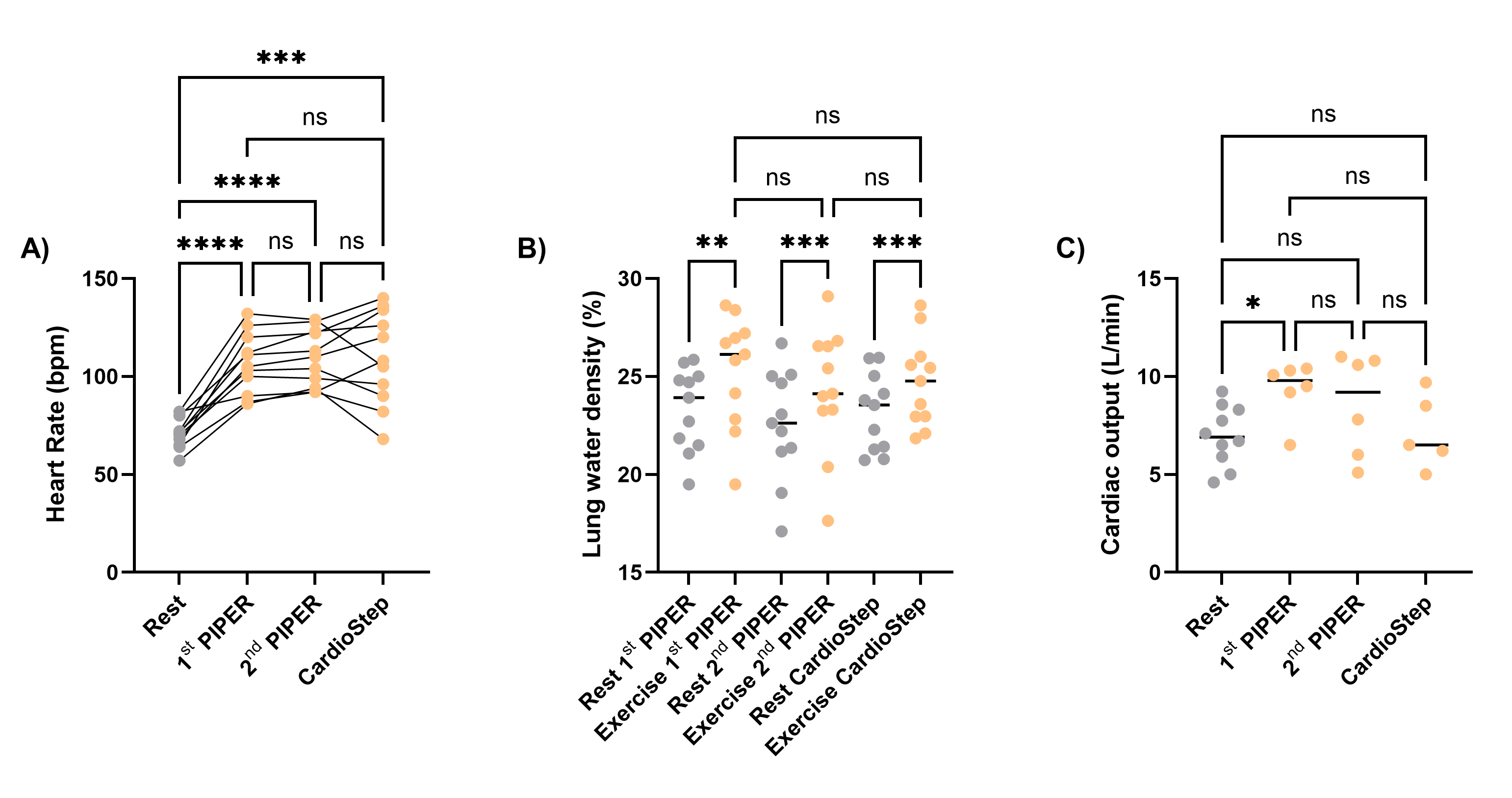
Values are represented as mean ± standard deviation. Difference to rest by one-way ANOVA: ns, non-significant; *, p< 0.050; **, p< 0.010; ***, p< 0.001, ****, p< 0.0001. SpO2, peripheral capillary oxygen saturation.Figure 1. Image of A) the in-house built half-pipe exercise rig (PIPER) and B) the commercially available CardioStep Module (Ergospect). C) The imaging protocol began with a short-axis (SAX) cine acquisition at rest, followed by a 6-minute dynamic lung water acquisition which comprised 3 minutes of rest and 3 minutes of exercise. Subsequently, another short-axis cine image was acquired during exercise. After subjects rested for at least 5 minutes to return to their resting heart rate, the lung water and exercise short-axis acquisitions were repeated twice. Half of the subjects exercised two rounds using the PIPER, followed by one round using the CardioStep. The other half started with the CardioStep before exercising two rounds with the PIPER..png) Figure 2. Illustration of changes between rest and exercise in A) heart rate, B) lung water density, and C) cardiac output using the half-pipe exercise rig (PIPER) and CardioStep exercise devices. One-way ANOVA: ns, non-significant; *, p<0.050; **, p<0.010; ***, p<0.001, ****, p<0.0001.
Figure 2. Illustration of changes between rest and exercise in A) heart rate, B) lung water density, and C) cardiac output using the half-pipe exercise rig (PIPER) and CardioStep exercise devices. One-way ANOVA: ns, non-significant; *, p<0.050; **, p<0.010; ***, p<0.001, ****, p<0.0001.