Oral Abstracts Session
Virtual Recording
Diego Pedraza, BSc
PhD Student
Pontificia Universidad Católica de Chile
Maipu, Santiago, Region Metropolitana, Chile

Claudia Prieto, PhD
Professor
Pontificia Universidad Católica de Chile / King's College London
Santiago, Region Metropolitana, Chile
Claudia Prieto, PhD
Professor
Pontificia Universidad Católica de Chile / King's College London
Santiago, Region Metropolitana, Chile

Carlos A. Castillo Passi, PhD
Research Engineer
Pontificia Universidad Catolica de Chile
Santiago, Region Metropolitana, Chile

Rene M. Botnar
Professor of Cardiovascular Imaging
Institute for Biological and Medical Engineering, Pontificia Universidad Católica de Chile
Santiago de Chile, Region Metropolitana, Chile
 Figure 2. In-vivo regional assessment of the proposed FR-cMRF approach against conventional maps. Average mean/spatial variability values for T1-MOLLI and T2-bSSFP maps are 619±43 ms and 53±5.8 ms, respectively. The mean/spatial variability T1 and T2 values for the proposed FR-cMRF sequence are 764±31 ms and 64±5 ms, respectively, showing higher quantification precision for both relaxation parameters.
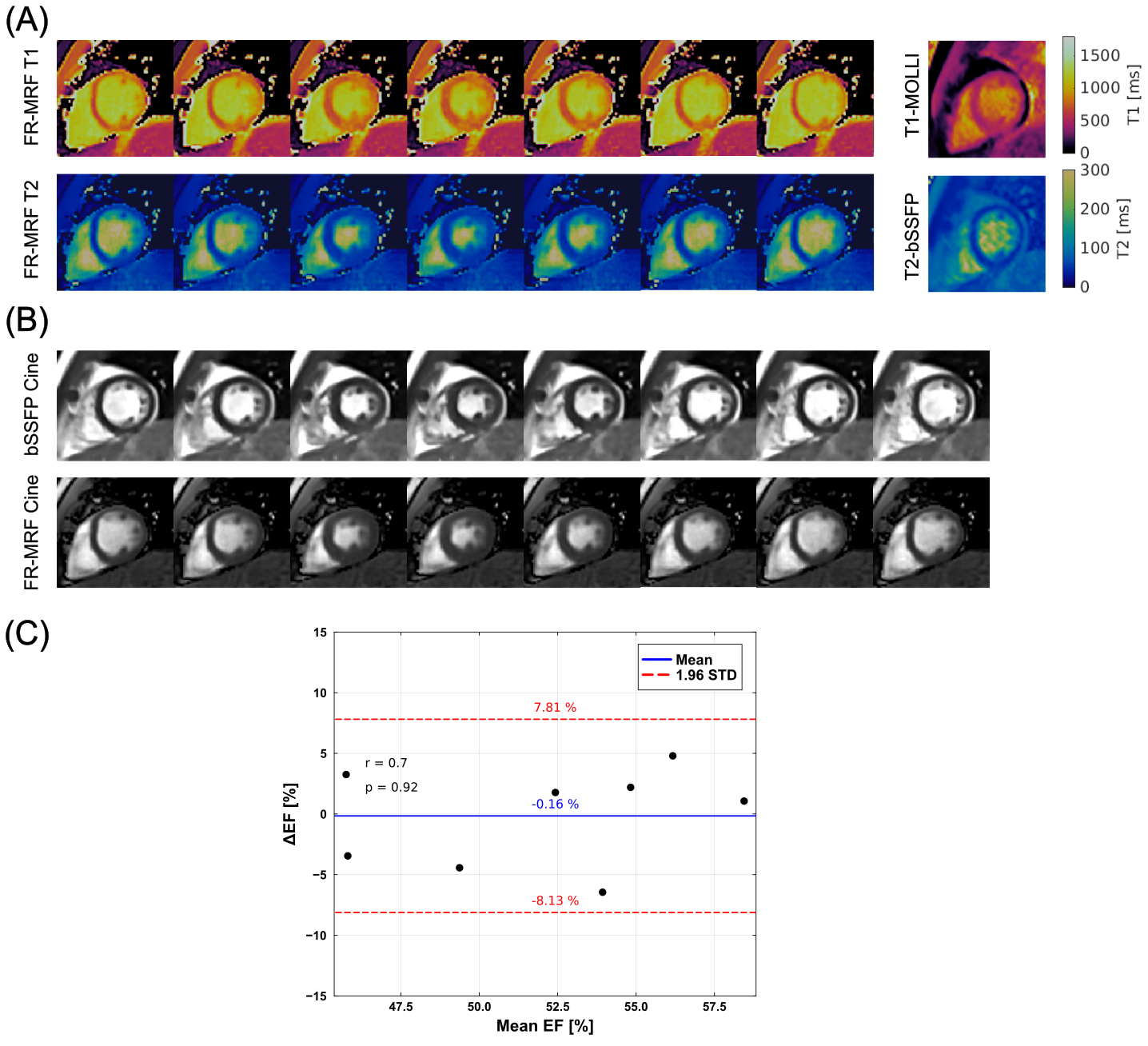
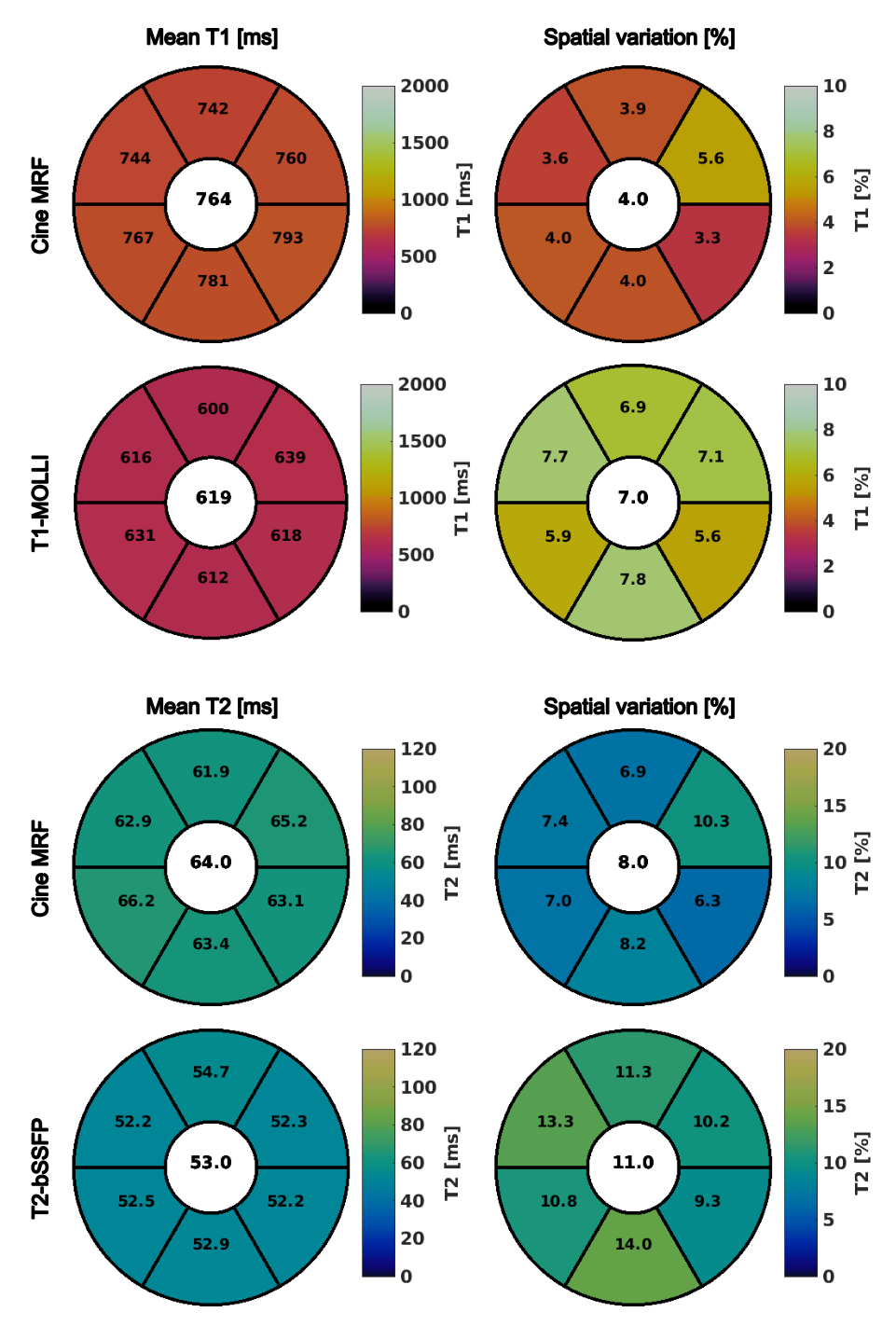 Figure 3. Free-running cardiac MRF In-vivo experiment. (A) FR-cMRF T1 and T2 maps are shown across several cardiac phases alongside with T1-MOLLI and T2-bSSFP maps acquired at diastole, for a representative healthy subject. (B) Reference bSSFP cine images are compared for 8 cardiac phases against the synthetic FR-cMRF cine images generated with the proposed method. (C) Bland-Altman plot shows a mean bias of -0.16% for ejection fraction estimation, with a high Pearson correlation index (r > 0.7) and a p-value=0.92, showing no relevant statistical differences between both sets of measurements.