Rapid Fire Session

RAFAEL FONSECA, BMSc
Biomedical Scientist
Heart Institute, University of São Paulo
São Paulo, Sao Paulo, Brazil

GABRIELLE N. LIMA, MD
Medical Doctor
Heart Institute, University of São Paulo
Senhor do Bonfim , Bahia, Brazil

Carlos Rochitte, MD, PhD, FSCMR
Associate Professor of Cardiology, Academic Coordinator of Cardiovascular Magnetic Resonance and Computed Tomography sector, and Medical Director of the Research Center at Heart Institute, InCor, University of São Paulo Medical School
Cardiovascular Magnetic Resonance and Computed Tomography Director at HCOR
Senior Medical Leader at Alta Excelência Diagnóstica, DASA, São Paulo
InCor - Univ. of São Paulo / HCOR - Heart Hospital
InCor - Univ. of São Paulo
São Paulo, Sao Paulo, Brazil
JULIANA BELLO, MD
HCOR, Brazil
| Total (n=105) | AR (n=32) | AS (n=73) | P |
AGE | 69.6 ± 33.6 | 54.6 ± 2.49 | 64.1 ± 0.98 | 0.0001 |
SEX FEMALE MALE |
|
|
| 0.114 |
38 (36.1%) 67 (63.8%) | 8 (25%) 24 (75%) | 30 (41.0%) 43 (58.9%) |
| |
DIABETES MELLITUS | 32 (30.4%) | 4 (12,5%) | 28 (38.3%) | 0.008 |
SAH | 94 (89.5%) | 30 (3.2%) | 73 (100%) | 0.349 |
CAD | 20 (19.0%) | 3 (9.3%) | 17 (23.2%) | 0.095 |
DYSLIPIDEMIA | 76 (72.3%) | 20 (62.5%) | 56 (76.7%) | 0.134 |
MEDICATIONS ACEI/ARB ß-BLOQUER DIURETICS STATIN |
|
|
|
|
70 (66.6%) | 27 (84.3%) | 43 (58.9%) | 0.011 | |
35 (33.3%) | 32 (100%) | 73 (100%) | 0.294 | |
72 (68.5%) | 22 (68.7%) | 50 (68.4%) | 0.979 | |
55 (52.2%) | 14 (43.7%) | 41 (56.1%) | 0.241 |
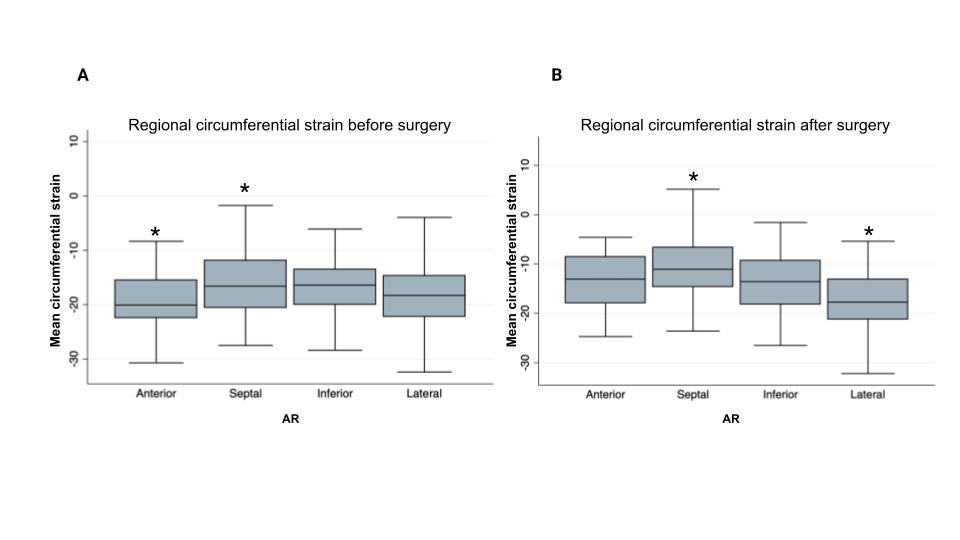
Data are expressed as mean ± standard deviation for numerical variables and as absolute values and percentages for categorical variables. AR= aortic faliture ; AS= aortic stenosis; SAH= Systemic Arterial Hypertension; CAD= Coronary Artery Disease; ACEI= Angiotensin-Converting Enzyme inhibitor ;ARB= Angiotensin Receptor Blocker;Figure 1: (A–B) Representation of regional circumferential strain obtained by cardiovascular magnetic resonance before (A) and after (B) surgical correction in patients with aortic regurgitation. (A) A heterogeneous contractility pattern is observed, with significantly greater strain in the septal segment compared to the anterior one, with the septum being the least contractile segment (p = 0.0001). (B) After surgery, regional heterogeneity becomes more pronounced, with emphasis on the difference between the septal and lateral segments (p = 0.0001). A more marked worsening in the septum and relative preservation of the lateral segment compared to the preoperative exam is also noted.