Rapid Fire Session

Julio Sotelo
Assistant Professor
Departamento de Informática, Universidad Técnica Federico Santa María
Santiago, Region Metropolitana, Chile
Sebastián Jara
PhD Candidate in Informatics Engineering
Universidad Técnica Federico Santa María, Santiago, Chile, Chile
Felipe Galarce, PhD
Assistant Professor
Pontificia Universidad Católica de Valparaíso, Chile
Hernan Mella, PhD
Assistant Professor
Pontificia Universidad Católica de Valparaíso, Chile
Ricardo Ñanculef, PhD
Professor of Computer Science
Universidad Técnica Federico Santa María, Chile
Rodrigo Salas, PhD
Professor of Computer Science
Universidad de Valparaíso, Chile

Philipp Beerbaum, MD
Professor
German Centre for Cardiovascular Research; University Children’s Hospital, Hannover Medical School
Hannover, Niedersachsen, Germany
Heynric B. Grotenhuis, MD, PhD
Pediatric Cardiologist
Wilhelmina Children's Hospital / University Medical Center Utrecht
Bilthoven, Utrecht, Netherlands
David Marlevi, PhD
Postdoctoral Fellow
Karolinska Institutet, Massachusetts, Sweden
Israel Valverde, MD, PhD
Pediatric Cardiologist
The Hospital for Sick Children
SickKids
Toronto, Ontario, Canada
Sergio Uribe, PhD
Professor
Monash University
Melbourne, Victoria, Australia
Julio Sotelo
Assistant Professor
Departamento de Informática, Universidad Técnica Federico Santa María
Santiago, Region Metropolitana, Chile
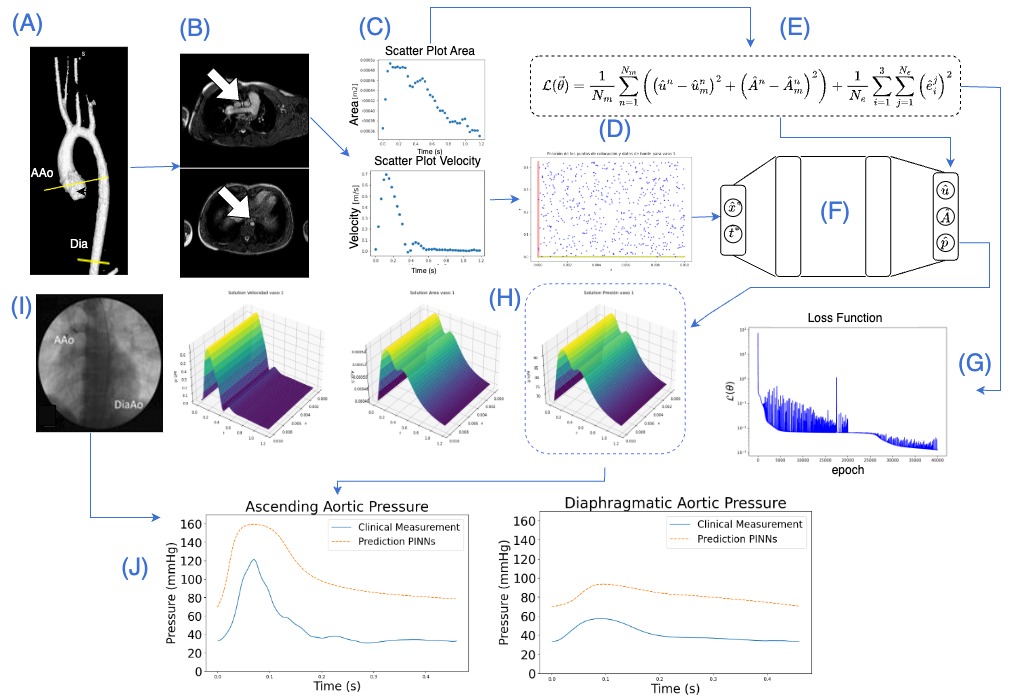 Figure 2. 1D Model for Blood Flow in Arteries: (A) Representation of a distensible vessel segment. A(x,t), u(x,t)and p(x,t) represent the area, mean velocity and mean pressure over a cross section, respectively. (B) Reduced 1D model of the Navier-Stokes equations for an incompressible fluid [6]. KR is a friction parameter, beta represents the vessel elasticity and depends on the vessel wall thickness and Young's modulus. pext and A0 are usually set to the diastolic pressure and the cross-sectional area in diastolic phase, respectively. Finally, rho is the density of blood which will be assumed equal to 1060 Kg/m3.
.png) Figure 3. (A) Peak-to-peak pressure gradient results under rest conditions. (B) Peak-to-peak pressure gradient results under stress conditions. In blue, peak-to-peak gradient measurements made by invasive catheterization. In orange, the simplified Bernoulli method. In green, the prediction made by the proposed PINNs approach.
Figure 3. (A) Peak-to-peak pressure gradient results under rest conditions. (B) Peak-to-peak pressure gradient results under stress conditions. In blue, peak-to-peak gradient measurements made by invasive catheterization. In orange, the simplified Bernoulli method. In green, the prediction made by the proposed PINNs approach. .png)