Rapid Fire Session

Tom Dresselaers, MSc
MR physicist
UZ Leuven - KU Leuven
Leuven, Vlaams-Brabant, Belgium
Tom Dresselaers, MSc
MR physicist
UZ Leuven - KU Leuven
Leuven, Vlaams-Brabant, Belgium
Peter Gatehouse, PhD
Research assistant
Oxford Centre for Clinical Magnetic Resonance Research (OCMR)
Oxford, England, United Kingdom
Frederik De Keyzer, BEng
MR physycist
University of Leuven
Leuven, Belgium
Anastasia Fambri, MD
CMR fellow, Cardiologist, MD
University of Leuven
Leuven, Belgium
Jan Bogaert, MD, PhD
Professor
UZ Leuven - KU Leuven
Leuven, Vlaams-Brabant, Belgium
n | LVEF (%) | peak GLS (%) | HR (bpm) | Dyssyn-chrony (% subjects) | |
CTRL | 49 | 58 (56 – 62) | -17.9 (-19.6 – -16.9) | 61 (54 – 68) | 0 |
EF< 35 | 17 | 20 (17 – 26) ***,$$$ | -7.3 ( -9.4 – -5.7) ***,$$$ | 77 (66 – 87) $$$ | 50 |
EF>=35 | 11 | 39 (36 – 49) NULL# | -14.1 (-15.7 – -12.0) NULL# | 68 (63 – 76) NULL# | 55 |
BAS | 17 | 25 (17 – 33) &&&,§§§ | -7.4 (-10.2 – -5.7) &&&,§§§ | 80 (73 – 91) &&,§§§ | 47 |
FU | 17 | 43 (38 – 48) £££ | -12.7 (-13.0 – -11.4) £££
| 67 (61 – 73)
| 19 |
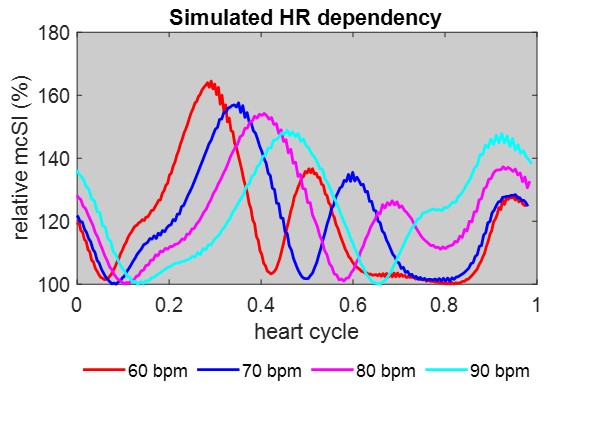
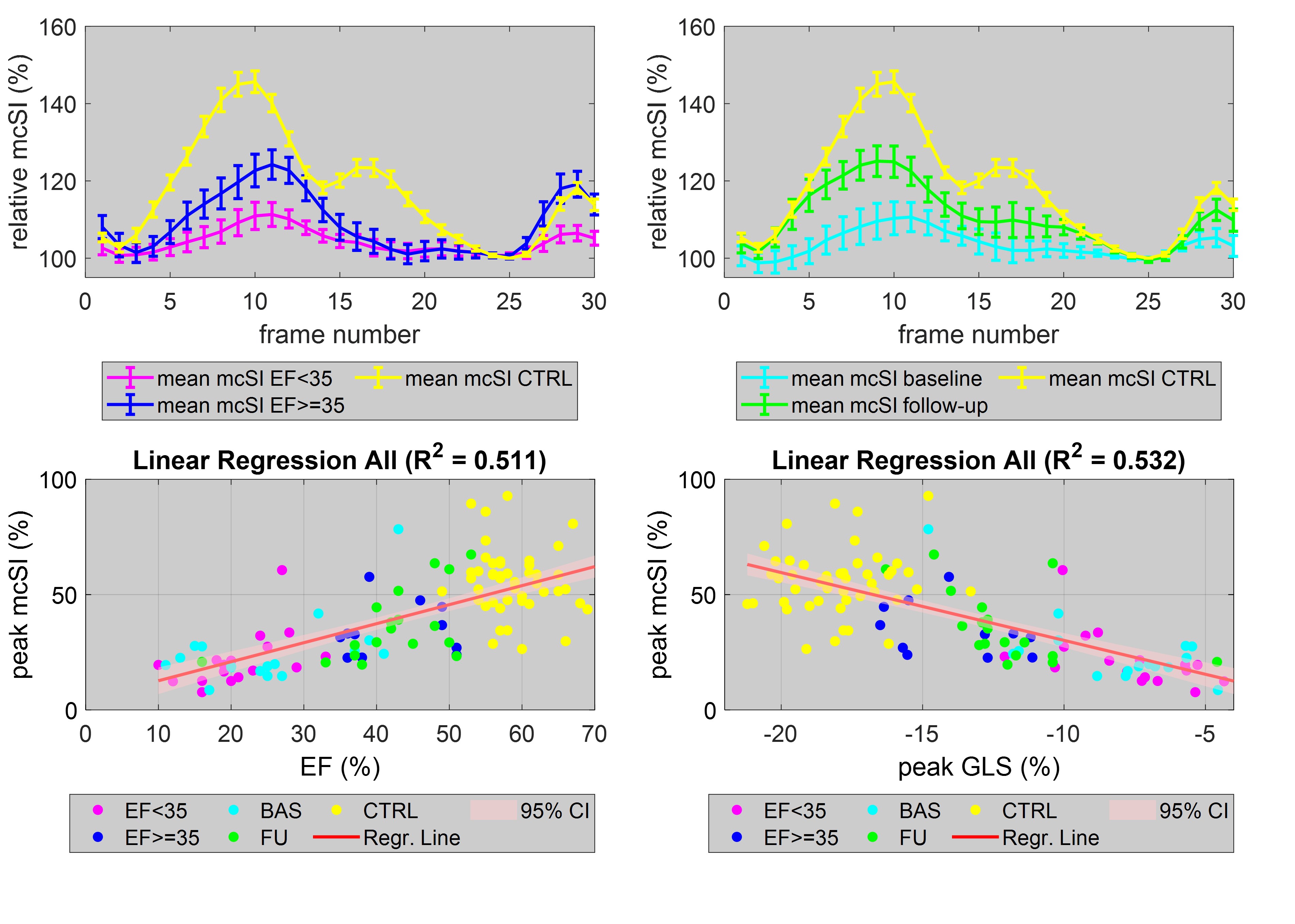 Figure 2: Heart rate (HR) dependency of the simulated myocardial signal intensity (mcSI) when modelling the cine magnetisation for through-plane motion as typical in healthy subjects. The horizontal axis is one cardiac cycle, as on the Figure 1 graphs. Although the heart rate changes significantly from baseline to recovery, or, between severe and moderately reduced EF (table 1), the in vivo change in mcSI (Fig. 1, top) are larger than the simulations predict and are correlated with functional parameters (Fig. 1, bottom).