Rapid Fire Session

Khalid Youssef, PhD, MSc
Assistant Professor
Indiana University, Department of Radiology and Imaging Sciences
Indianapolis, Indiana, United States
Khalid Youssef, PhD, MSc
Assistant Professor
Indiana University, Department of Radiology and Imaging Sciences
Indianapolis, Indiana, United States

Rohan Dharmakumar, PhD
Executive Director
Indiana University School of Medicine
Indianapolis, Indiana, United States

KEYUR P. VORA, MD, MSc, FSCMR
Assistant Professor of Medicine
Indiana University School of Medicine
RAJKOT, Gujarat, India
.png) Figure 2. Illustrative examples: this figure shows two illustrative examples of reperfused STEMI patients without IMH (-) and with IMH (+) . Left Column: Troponin kinetics feature maps. Middle columns: short-axis CMR at 48–72 h—LGE and T2*. Top row (IMH −Ve): no hypointense myocardial region on T2*. Bottom row (IMH +Ve): hypointense region (arrowheads) consistent with intramyocardial hemorrhage. The IMH+ example shows larger early and late exposure, illustrating how most discriminative signal is captured by early-phase features while late-phase kinetics remain biologically informative.
Figure 2. Illustrative examples: this figure shows two illustrative examples of reperfused STEMI patients without IMH (-) and with IMH (+) . Left Column: Troponin kinetics feature maps. Middle columns: short-axis CMR at 48–72 h—LGE and T2*. Top row (IMH −Ve): no hypointense myocardial region on T2*. Bottom row (IMH +Ve): hypointense region (arrowheads) consistent with intramyocardial hemorrhage. The IMH+ example shows larger early and late exposure, illustrating how most discriminative signal is captured by early-phase features while late-phase kinetics remain biologically informative..png) Figure 3. Results. A. Five-fold stratified Cross-Validation ROC curves comparing three models: All features (AUC = 0.9037), Early phase features (AUC = 0.9015), and Late phase features (AUC = 0.8909). The near overlap between all features and Early features indicates that most discriminative power is available within the early-phase features, with limited incremental gain from late-phase kinetics. B. Optimized SNN model identified AUC of 0–12h, AUC of 0–6h, and Max rise slope as the optimal feature combination for predicting IMH. The model had an AUC of 90.03%, virtually matching the state-of-the-art MST model that uses all the features. C. Global feature importance (average AUC loss under feature permutation) for the top 5 contributors: AUC of 0–12h and Peak value dominate, followed by AUC of 12–24h, AUC of 0–6h, and Max rise slope. D. Optimal feature subset: AUC of 0–12h, AUC of 0–6h and Max rise slope were identified as the optimal combination of features for predicting IMH, consistent with early-phase dominance and late-phase redundancy.
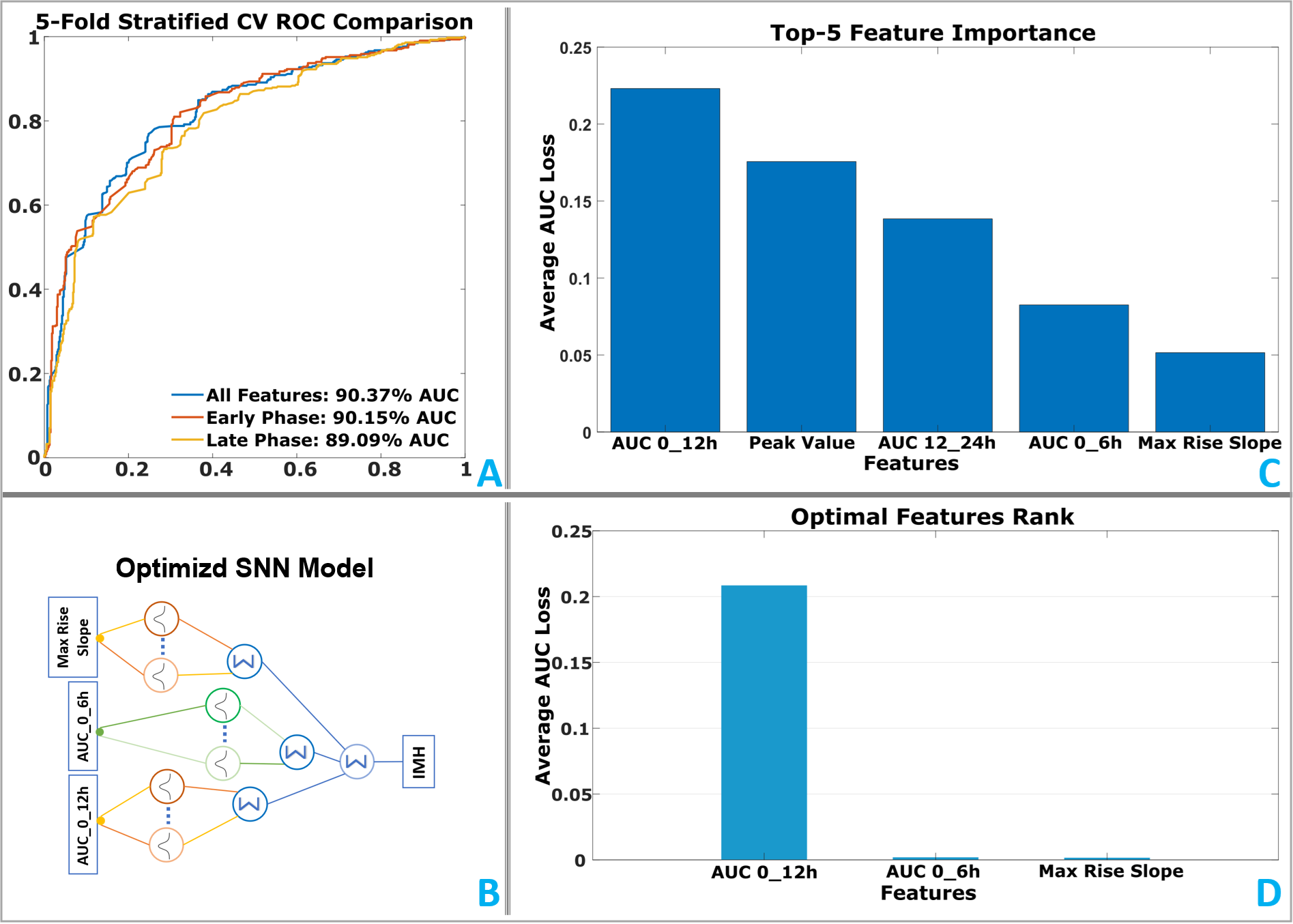
Figure 3. Results. A. Five-fold stratified Cross-Validation ROC curves comparing three models: All features (AUC = 0.9037), Early phase features (AUC = 0.9015), and Late phase features (AUC = 0.8909). The near overlap between all features and Early features indicates that most discriminative power is available within the early-phase features, with limited incremental gain from late-phase kinetics. B. Optimized SNN model identified AUC of 0–12h, AUC of 0–6h, and Max rise slope as the optimal feature combination for predicting IMH. The model had an AUC of 90.03%, virtually matching the state-of-the-art MST model that uses all the features. C. Global feature importance (average AUC loss under feature permutation) for the top 5 contributors: AUC of 0–12h and Peak value dominate, followed by AUC of 12–24h, AUC of 0–6h, and Max rise slope. D. Optimal feature subset: AUC of 0–12h, AUC of 0–6h and Max rise slope were identified as the optimal combination of features for predicting IMH, consistent with early-phase dominance and late-phase redundancy.