Rapid Fire Session
Changyu Sun
Assistant Professor
University of Missouri-Columbia
Columbia, Missouri, United States
Changyu Sun
Assistant Professor
University of Missouri-Columbia
Columbia, Missouri, United States
Yu Wang, PhD
Imaging scientist
University of Missouri, Columbia, United States
Senthil Kumar, MD
Associate Professor
University of Missouri, United States
Talissa A. Altes, MD, MSc
Professor
University of Missouri
Columbia, Missouri, United States
 Figure 2. Evaluation of CineGen on a retrospective patient data across multiple cardiac phases, and temporal profile plots. (A) Example images for a patient with synthetic low resolution across multiple cardiac phases. The low-resolution input was zero-padded using central 38% phase-encoding lines. CineGen demonstrates sharper myocardial borders and reduced artifacts compared to REGAIN and shows better consistency with the reference HR images. (B) Corresponding spatiotemporal (x–t and y–t) profiles extracted from the boxed regions. CineGen generates clearer myocardial wall motion patterns with preserved temporal fidelity, reducing aliasing and temporal artifacts observed in low-resolution and REGAIN super-resolved images. (C) Quantitative comparisons were performed on all cine MRI images, including a total of 120 short-axis slices from 12 independent subjects using HR cine MRI (spatial resolution 1.4-1.5 × 1.4-1.5mm2) as the reference in terms of Structural Similarity Index (SSIM), normalized Root-Mean-Square-Error (nRMSE) and Peak Signal-to-Noise Ratio (PSNR). CineGen demonstrated better performance on all three metrics compared to REGAIN, with lower nRMSE, higher PSNR, and higher SSIM (P < 0.05 for all metrics using paired t-test).
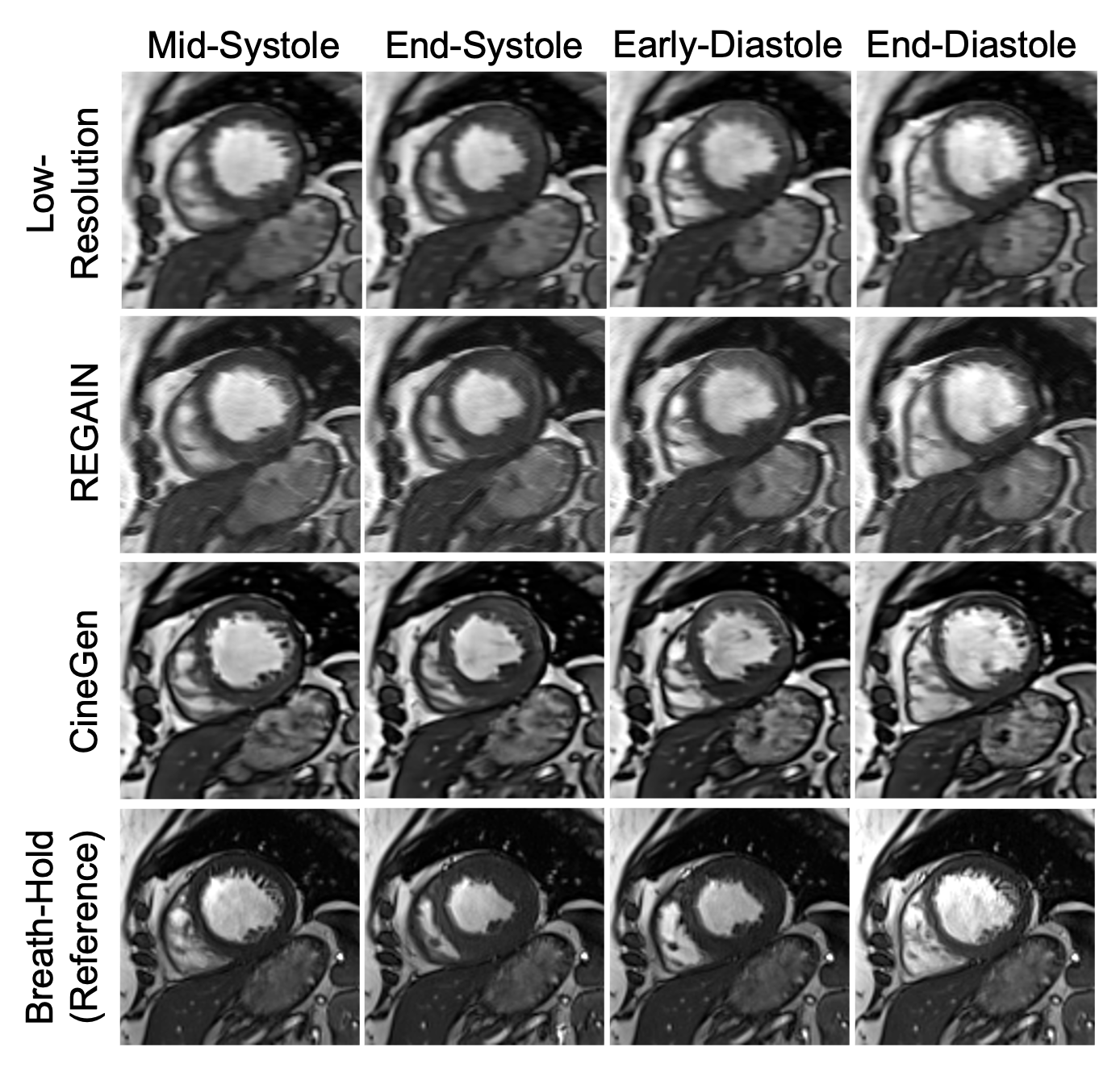
 .png) Figure 3. Comparisons of REGAIN and CineGen for super-resolution of prospectively acquired free-breathing real-time cardiac cine MRI from one patient with ~21-fold acceleration (38% phase-encoding lines, compressed sensing rate 8). Representative short-axis frames across the cardiac cycle reconstructed with different methods were shown, including low-resolution image reconstructed from 38% phase-encoding lines and 8-fold compressed sensing, REGAIN super-resolution, and CineGen super-resolution. The real-time acquisition was performed at 1.4 × 1.4 mm² spatial resolution, 30.7 ms temporal resolution. CineGen improves myocardial border sharpness, image contrast and overall image quality compared to low-resolution input and REGAIN and showed superior consistency with the reference breath-hold images separately acquired at the same location.
Figure 3. Comparisons of REGAIN and CineGen for super-resolution of prospectively acquired free-breathing real-time cardiac cine MRI from one patient with ~21-fold acceleration (38% phase-encoding lines, compressed sensing rate 8). Representative short-axis frames across the cardiac cycle reconstructed with different methods were shown, including low-resolution image reconstructed from 38% phase-encoding lines and 8-fold compressed sensing, REGAIN super-resolution, and CineGen super-resolution. The real-time acquisition was performed at 1.4 × 1.4 mm² spatial resolution, 30.7 ms temporal resolution. CineGen improves myocardial border sharpness, image contrast and overall image quality compared to low-resolution input and REGAIN and showed superior consistency with the reference breath-hold images separately acquired at the same location.