Oral Abstracts Session
Virtual Recording
Xinqi Li, MSc
Ph.D student
Cedars-Sinai Medical Center
Berlin, Berlin, Germany
Xinqi Li, MSc
Ph.D student
Cedars-Sinai Medical Center
Berlin, Berlin, Germany
Yi Zhang
PhD candidate
Delft University of Technology, Netherlands
Li-Ting Huang, MD, MSc
radiologist
National Cheng Kung University Hospital
Los Angeles, California, United States
Thoralf Niendorf, PhD
Prof.Dr.
Berlin Ultrahigh Field Facility (B.U.F.F.), Max Delbrueck Center for Molecular Medicine in the Helmholtz Association, Berlin, Germany. Experimental and Clinical Research Center, Charite Medical Faculty and the Max Delbrueck Center for Molecular Medicine in the Helmholtz Association, Berlin, Germany. DZHK (German Centre for Cardiovascular Research), partner site Berlin, Berlin, Germany.
Berlin, Berlin, Germany
Kim-Lien Nguyen, MD
Associate Professor of Cardiovascular Medicine and Radiology
David Geffen School of Medicine at UCLA and VA Greater Los Angeles Healthcare System
Los Angeles, California, United States
Min-Chi Ku, PhD
Senior researcher
Berlin Ultrahigh Field Facility (B.U.F.F.), Max Delbrueck Center for Molecular Medicine in the Helmholtz Association, Berlin, Germany. DZHK (German Centre for Cardiovascular Research), partner site Berlin, Berlin, Germany
Berlin, Berlin, Germany
Qian Tao, PhD
Assistant Professor
Delft University of Technology
Delft, Zuid-Holland, Netherlands
.jpeg "Hsin-Jung (Randy) Yang, PhD photo")
Hsin-Jung (Randy) Yang, PhD
Associate Professor
Biomedical Imaging Research Institute, Cedars-Sinai Medical Center, Los Angeles, CA, USA
Los Angeles, California, United States
 Figure 2: First-level intra-series registration performance. (A) The registration results of in-domain T1 MOLLI sequence(Human, post contrast), (B) Anatomical difference (from human to large animal), and (C) Model difference (from T1 to T2 Relaxation). The representative images and boxplot demonstrated the improvement of using our proposed method comparing to others in both global dice score and fitting performance in all three cases.
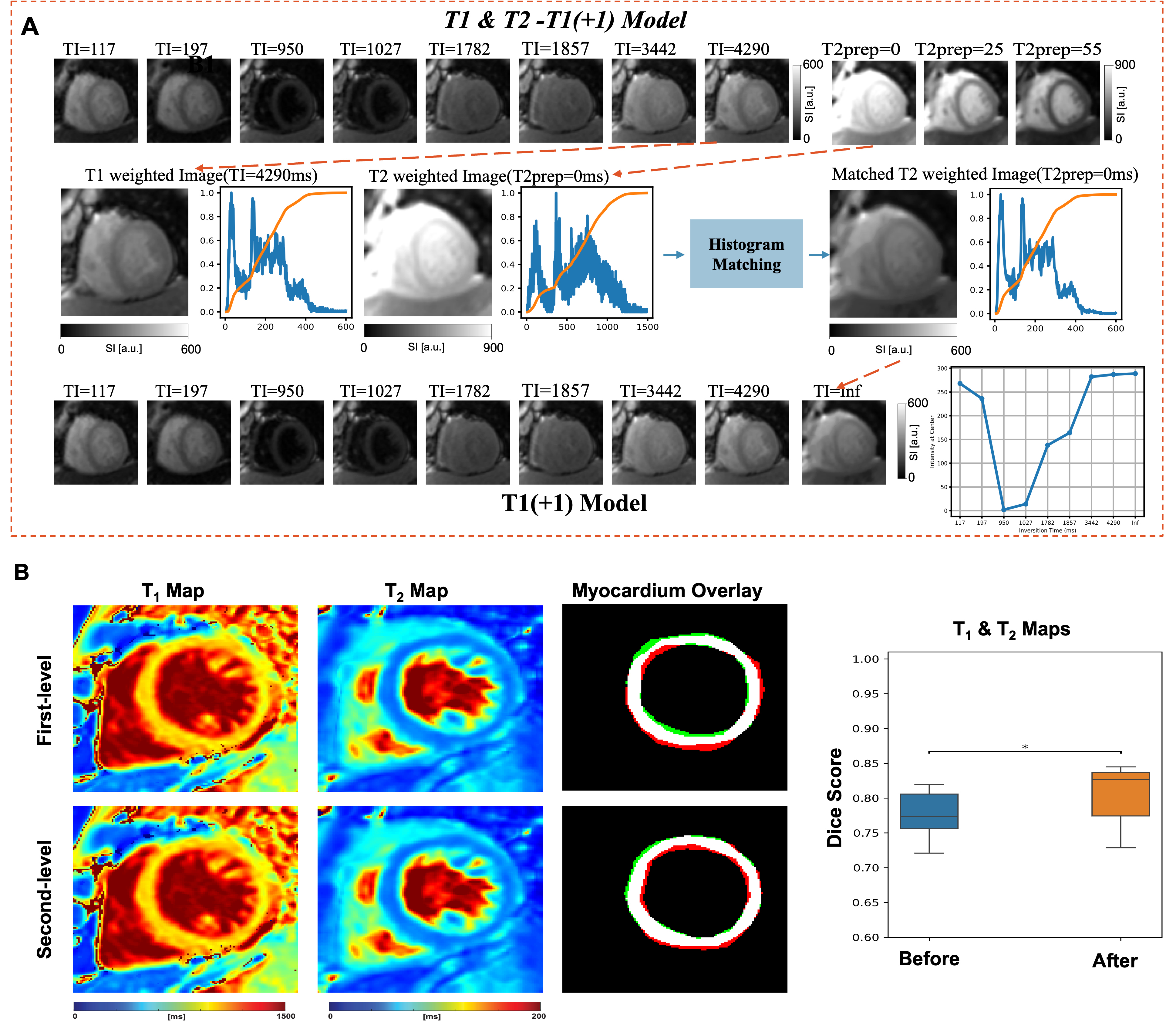
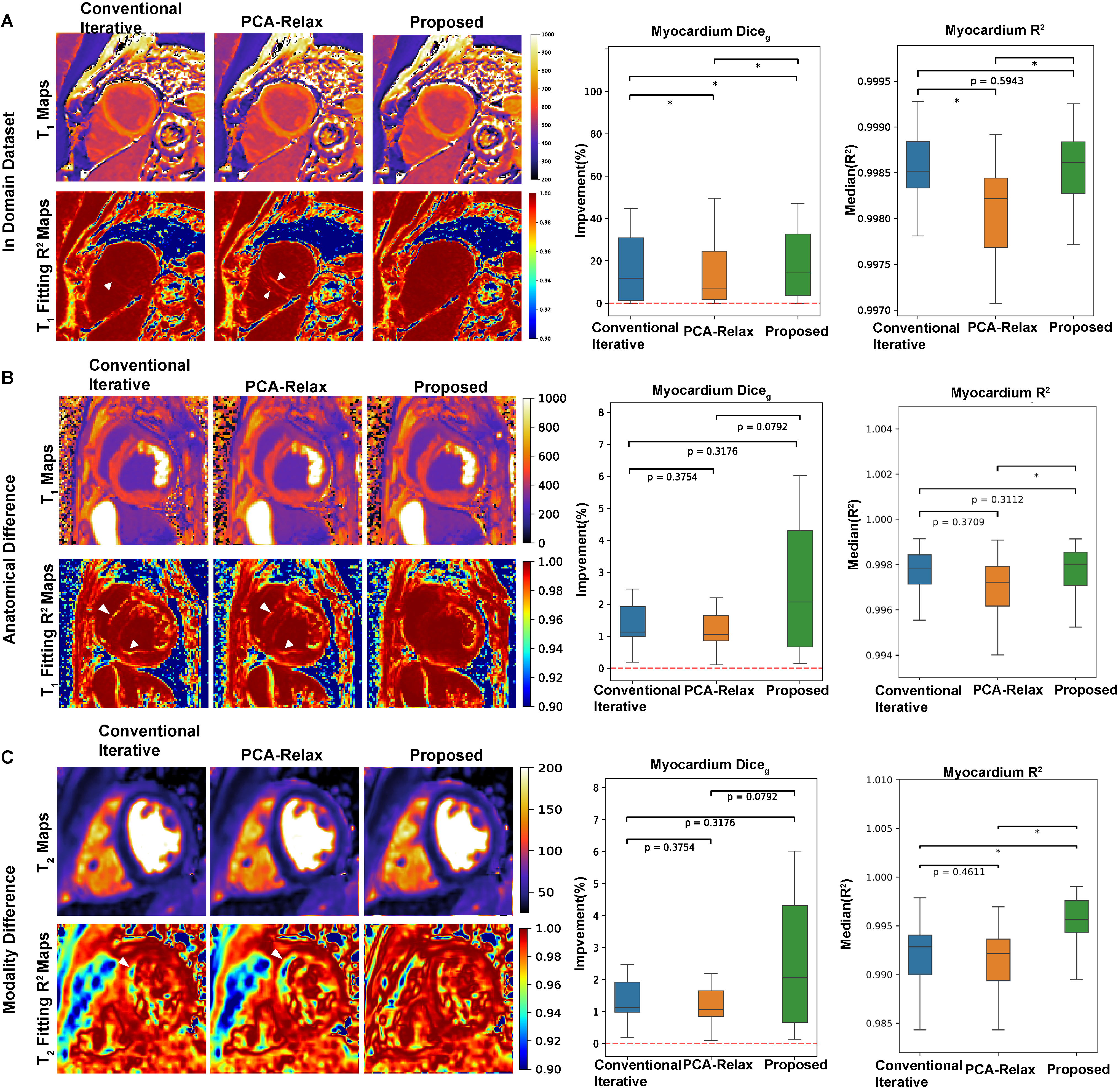 Figure 3 Second-level inter-series registration performance. (A) The T1+(1) physics model was applied in the second level for inter-subject registration between T1 and T2 weighted images. This approach treats the first T2-weighted image as a fully recovered T1-weighted image. The images were preprocessed using histogram matching to normalize the intensity difference between the imaging protocols. The combined series, including all T1-weighted images and the intensity-matched first T2-weighted image, then serves as input to the second-level registration. (B) Representative images and dice score comparison of T1 and T2 maps before and after the second level registration. The red and green masks denote the T1 and T2 mapping's myocardial masks and the white region denote the overlay region. The statistical results showed significant improvement in the dice score after registration.