Oral Abstracts Session
Virtual Recording

Zhuoan Li, MSc
PhD Candidate
Laboratory for Translational Imaging for Microcirculation, Weldon School of Biomedical Engineering, Purdue University
Indianapolis, Indiana, United States
Zhuoan Li, MSc
PhD Candidate
Laboratory for Translational Imaging for Microcirculation, Weldon School of Biomedical Engineering, Purdue University
Indianapolis, Indiana, United States

M. Berk Sahin
PhD student
Purdue University
West Lafayette, Indiana, United States
Dilek M. Yalcinkaya, MSc
PhD Candidate
Purdue University
West Lafayette, Indiana, United States
Arian M. Sohi, BSc
PhD Student
Laboratory for Translational Imaging for Microcirculation, Weldon School of Biomedical Engineering, Purdue University
Indianapolis, Indiana, United States
Luis Zamudio, BSc
Research Engineer
Purdue University
Indianapolis, Indiana, United States
Khalid Youssef, PhD, MSc
Assistant Professor
Indiana University, Department of Radiology and Imaging Sciences
Indianapolis, Indiana, United States

Michael D. Elliott, MD
Director of Cardiac MRI
Atrium Health
Charlotte, North Carolina, United States

Venkateshwar Polsani, MD
Director of Cardiovascular Imaging
Piedmont Heart Institute
Atlanta, Georgia, United States
Matthew S. Tong, DO
Associate Professor - Clinical
The Ohio State University
Columbus, Ohio, United States

Dipan J. Shah, MD
Chief, Division of Cardiovascular Imaging Director, Cardiovascular MRI Laboratory
Weill Cornell Medical College, Houston Methodist DeBakey Heart and Vascular Center, Houston, Texas, USA
Houston, Texas, United States

Orlando P. Simonetti, PhD, FSCMR
Professor
The Ohio State University
Columbus, Ohio, United States
Behzad Sharif, PhD
Associate Professor
Purdue University
Indianapolis, Indiana, United States
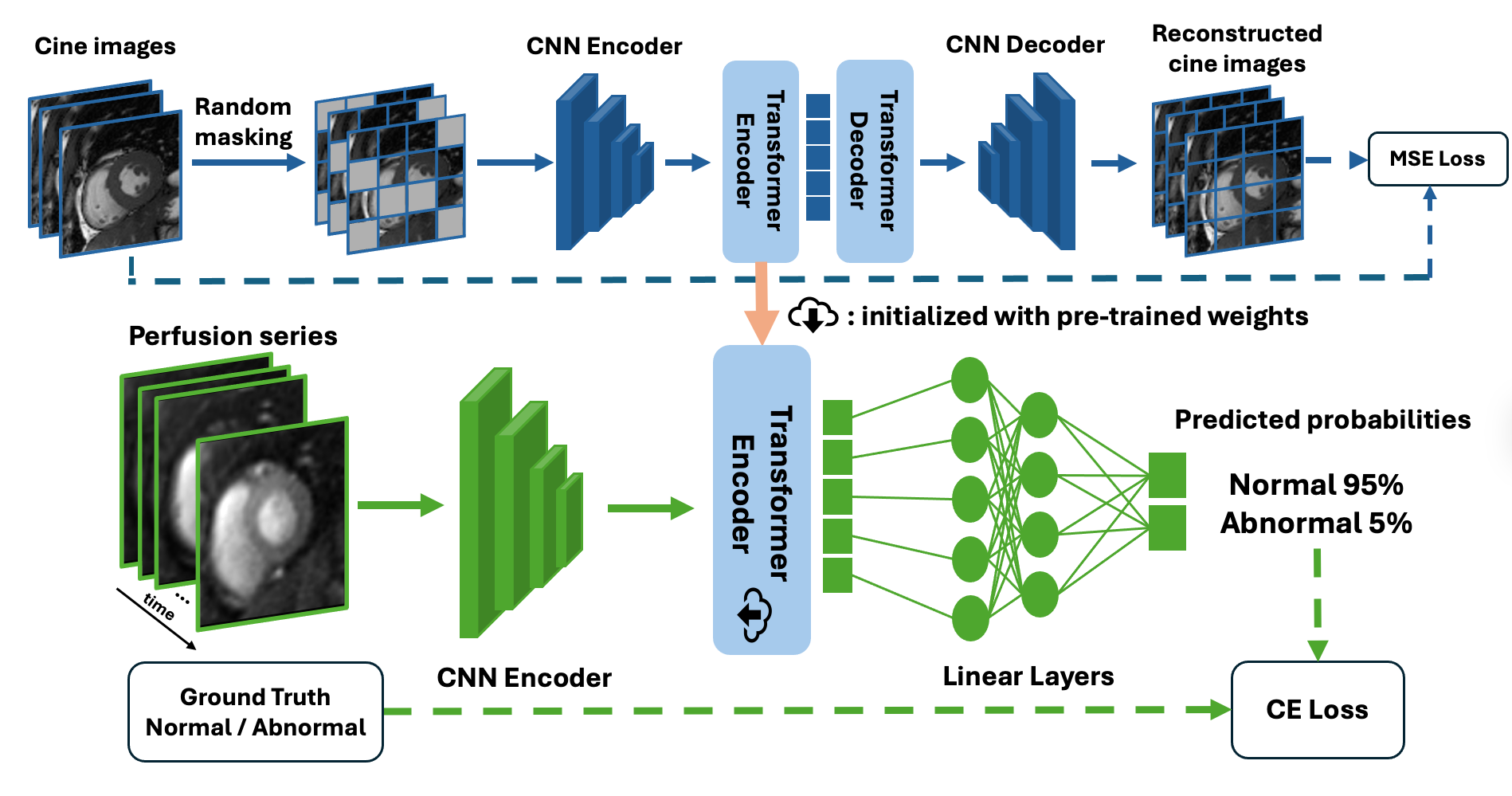 Figure 2. Representative stress FPP cases from a four-center dataset derived from the SCMR Registry with binary classification (normal vs. abnormal) using the proposed fine-tuned foundation model (FM) approach vs. alternative deep-learning-based approaches. Two representative stress FPP CMR series are shown with corresponding 17-segment bullseye maps providing ground-truth perfusion scores. Binary classification was defined by the summed stress score (summed score >1 considered abnormal). For each case, predicted class probabilities from the proposed fine-tuned foundation model and the two alternative methods (CNN and ResNet) are reported on the right-handed side. Top row: an abnormal case with subendocardial perfusion defects (green arrows) scored as abnormal as seen in the bull's eye map (scores from the SCMR registry). Our proposed fine-tuned FM approach correctly classified it as abnormal with high confidence (89.9%), whereas CNN and ResNet classifiers misclassified it as normal. Bottom row: A normal case correctly identified by our model as normal (82.0% probability) and misclassified by CNN and ResNet.
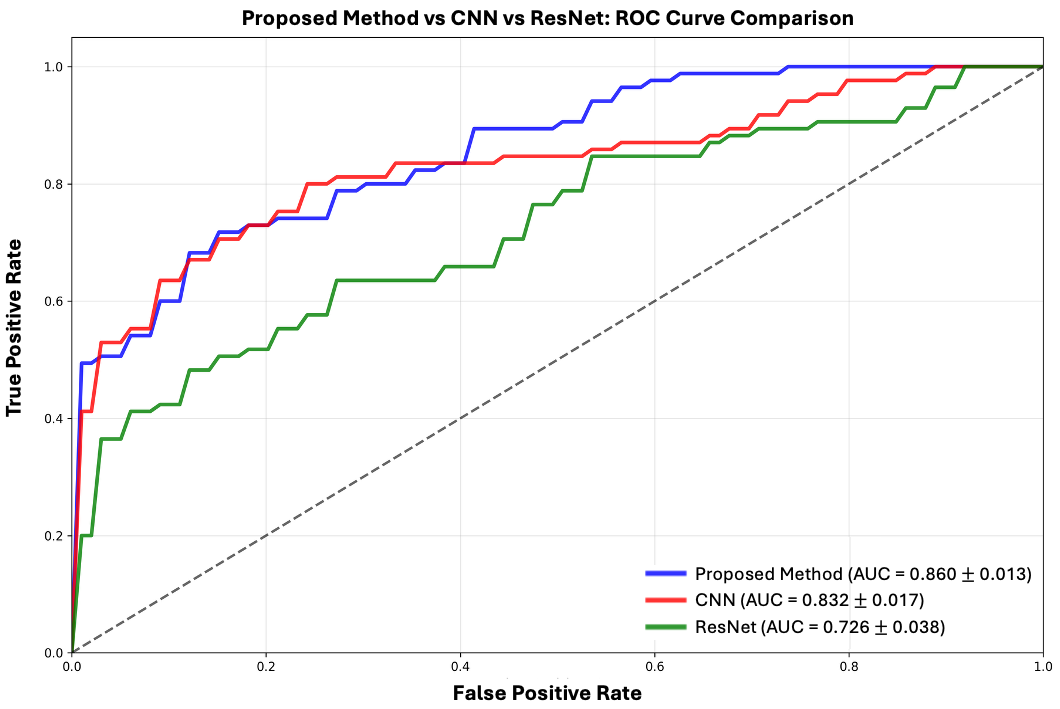
 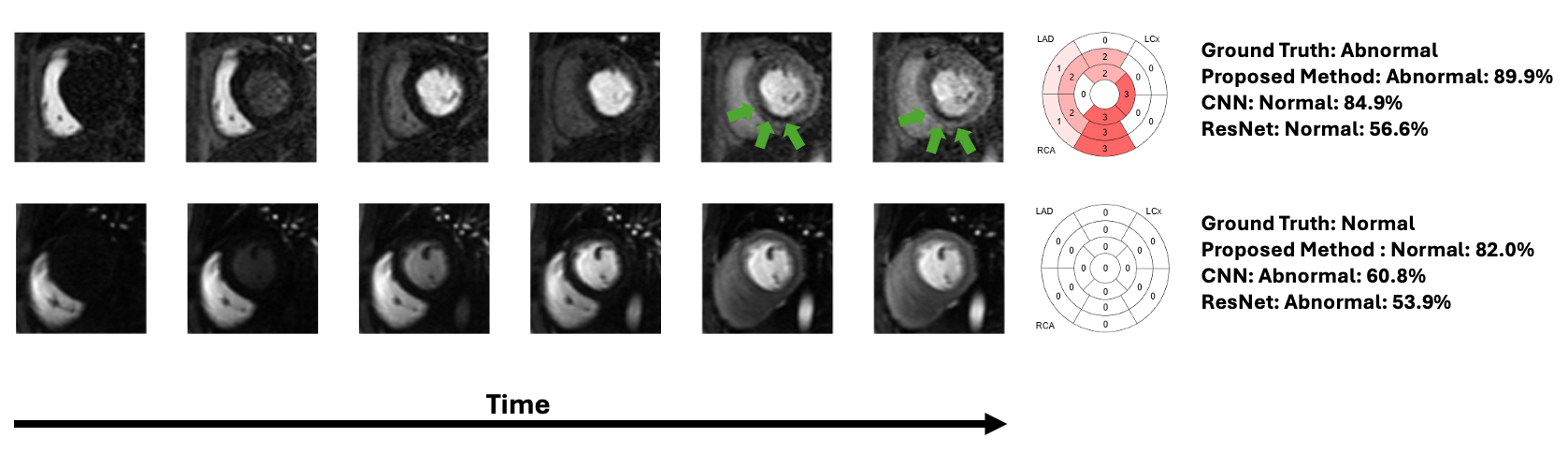 Figure 3. Comparison of the diagnostic performance of the proposed fine-tuned FM approach versus the two alternative deep learning-based methods (CNN and ResNet) using receiver operating characteristic (ROC) curve and 5-fold cross-validation. The multi-center dataset was derived from the SCMR Registry. Across folds, the proposed method achieved the highest overall AUC (0.860 ± 0.013), outperforming CNN (0.832 ± 0.017) and ResNet (0.726 ± 0.038) with p<0.01 for both comparisons.