Rapid Fire Session
Hazar Benan Unal, PhD
Postdoctoral Research Associate
Laboratory for Translational Imaging of Microcirculation, Purdue University
Indianapolis, Indiana, United States
Hazar Benan Unal, PhD
Postdoctoral Research Associate
Laboratory for Translational Imaging of Microcirculation, Purdue University
Indianapolis, Indiana, United States
Shahriar Zeynali, MSc
PhD Candidate
Indiana University School of Medicine
Indianapolis, Indiana, United States
Arian M. Sohi, BSc
PhD Student
Laboratory for Translational Imaging for Microcirculation, Weldon School of Biomedical Engineering, Purdue University
Indianapolis, Indiana, United States
Eric Anttila, PhD
Research Engineer
MED Institute, United States
David Gross, PhD
Director of MRI Safety Evaluations and Engineering Simulations
MED Institute
West Lafayette, Indiana, United States
Behzad Sharif, PhD
Associate Professor
Purdue University
Indianapolis, Indiana, United States
.png) Figure 2: Representative swine study demonstrating total blood volume (TBV) estimation from serial ferumoxytol-enhanced T1 mapping. (A) Free-breathing SR-bSSFP–based T1 maps at baseline (native), and at 16 and 24 minutes post-infusion, with blood pool ROIs indicated with corresponding T1 value are shown. As expected, blood T1 drops dramatically following ferumoxytol infusion. Also, the blood T1 increases from t=16 min to t=24 minutes as a result of ferumoxytol clearance. (B) (Left) Recovery of blood pool T1 values from the free-breathing SR-bSSFP T1 mapping over ~60 minutes following ferumoxytol infusion. (Right) Linear fitting of the logarithm of the normalized distribution volume V′(t) vs. time. The y-intercept yields the estimated TBV. (C) Corresponding MOLLI-derived measurements from the same animal for validation, showing comparable T1 recovery kinetics and TBV estimation.
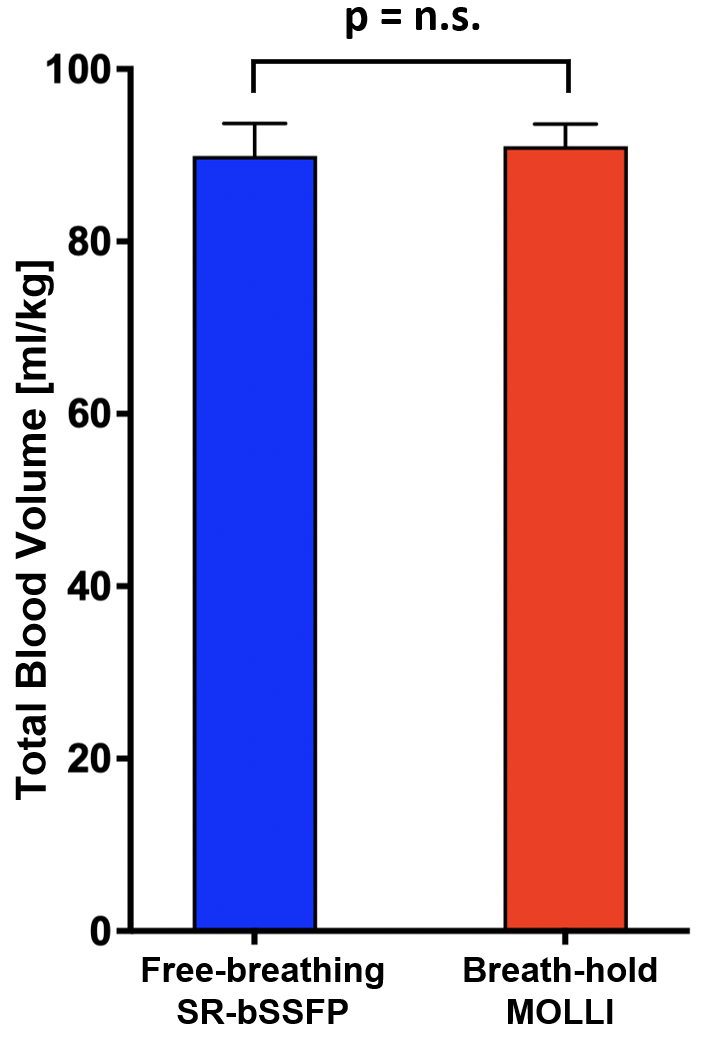
Figure 2: Representative swine study demonstrating total blood volume (TBV) estimation from serial ferumoxytol-enhanced T1 mapping. (A) Free-breathing SR-bSSFP–based T1 maps at baseline (native), and at 16 and 24 minutes post-infusion, with blood pool ROIs indicated with corresponding T1 value are shown. As expected, blood T1 drops dramatically following ferumoxytol infusion. Also, the blood T1 increases from t=16 min to t=24 minutes as a result of ferumoxytol clearance. (B) (Left) Recovery of blood pool T1 values from the free-breathing SR-bSSFP T1 mapping over ~60 minutes following ferumoxytol infusion. (Right) Linear fitting of the logarithm of the normalized distribution volume V′(t) vs. time. The y-intercept yields the estimated TBV. (C) Corresponding MOLLI-derived measurements from the same animal for validation, showing comparable T1 recovery kinetics and TBV estimation.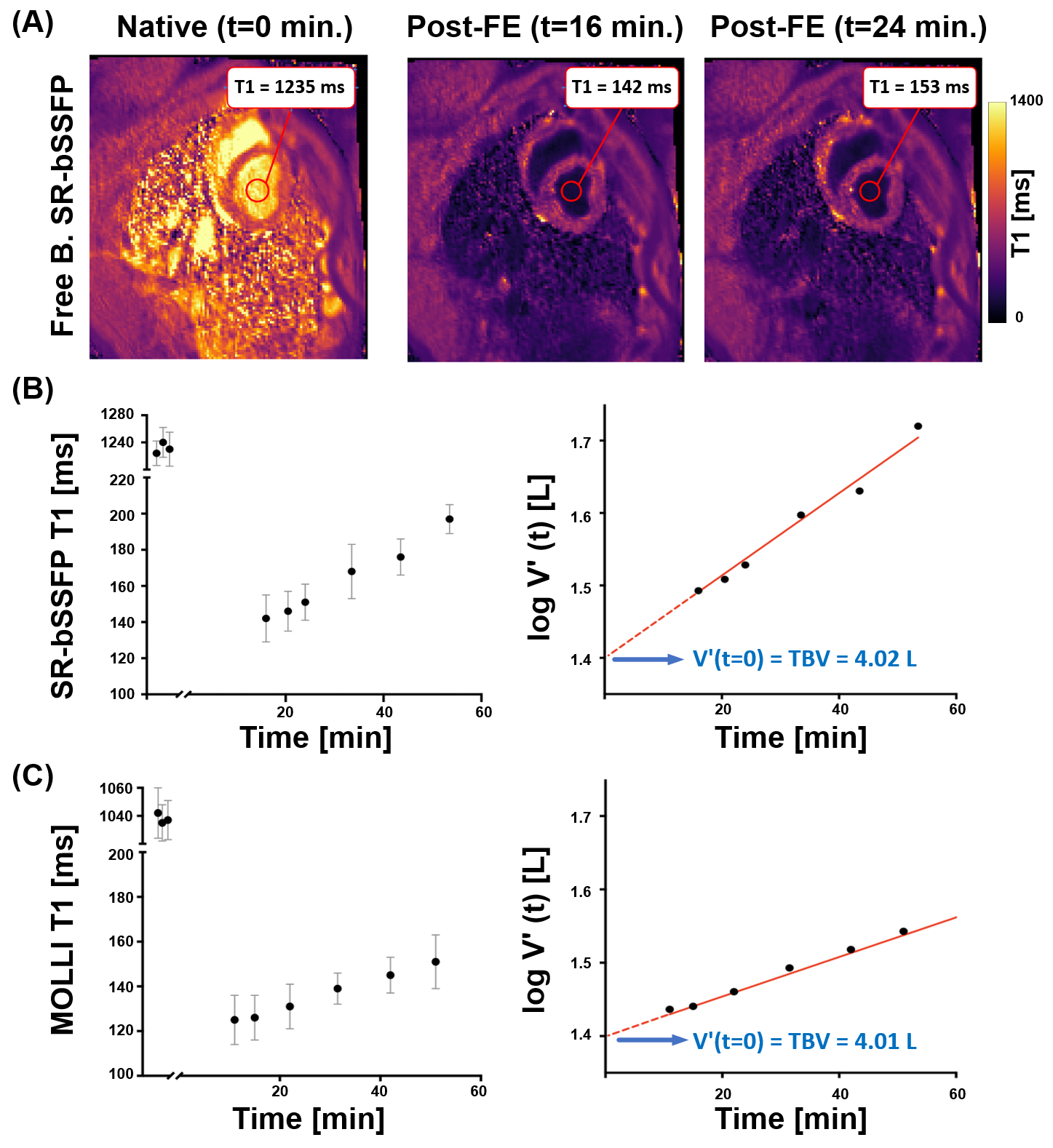 Figure 3: Comparison of total blood volume (TBV) estimates derived from free-breathing SR-bSSFP and breath-hold MOLLI T1 mapping. Group-averaged TBV was 89.9 ± 3.8 mL/kg for SR-bSSFP (free-breathing) and 91.0 ± 2.6 mL/kg for MOLLI (breath-hold), with no statistically significant difference demonstrating the agreement between the two methods. These results validate the feasibility of free-breathing SR-bSSFP acquisitions for TBV quantification, with accuracy comparable to the standard breath-hold MOLLI approach.