Rapid Fire Session

Michael Salerno, MD, PhD
Professor of Medicine and Radiology and Biomedical Imaging
UCSF
Belmont, California, United States
Quan Chen, PhD
Postdoc
University of California San Francisco, United States
.jpg "Junyu Wang, PhD photo")
Junyu Wang, PhD
Postdoctoral Scholar
Stanford University
Palo Alto, California, United States
Xitong Wang, MSc
PhD Student
Stanford University
Santa Clara, California, United States
Shen zhao
Postdoc
University of California San Francisco
Santa Clara, California, United States
Sizhuo Liu, PhD
Postdoc
University of California San Francisco
San Francisco, California, United States
 Figure 2. Two representative frames from the MOCO-DESIRE reconstructions and the corresponding VoxelMorph-predicted deformation fields with and without motion-augmented training. The first row shows pixelwise deformation field magnitudes, where larger values indicate greater estimated motion. Red arrows highlight regions in the heart where motion-augmented training enabled VoxelMorph to capture more motion, leading to sharper reconstructions in the second row.
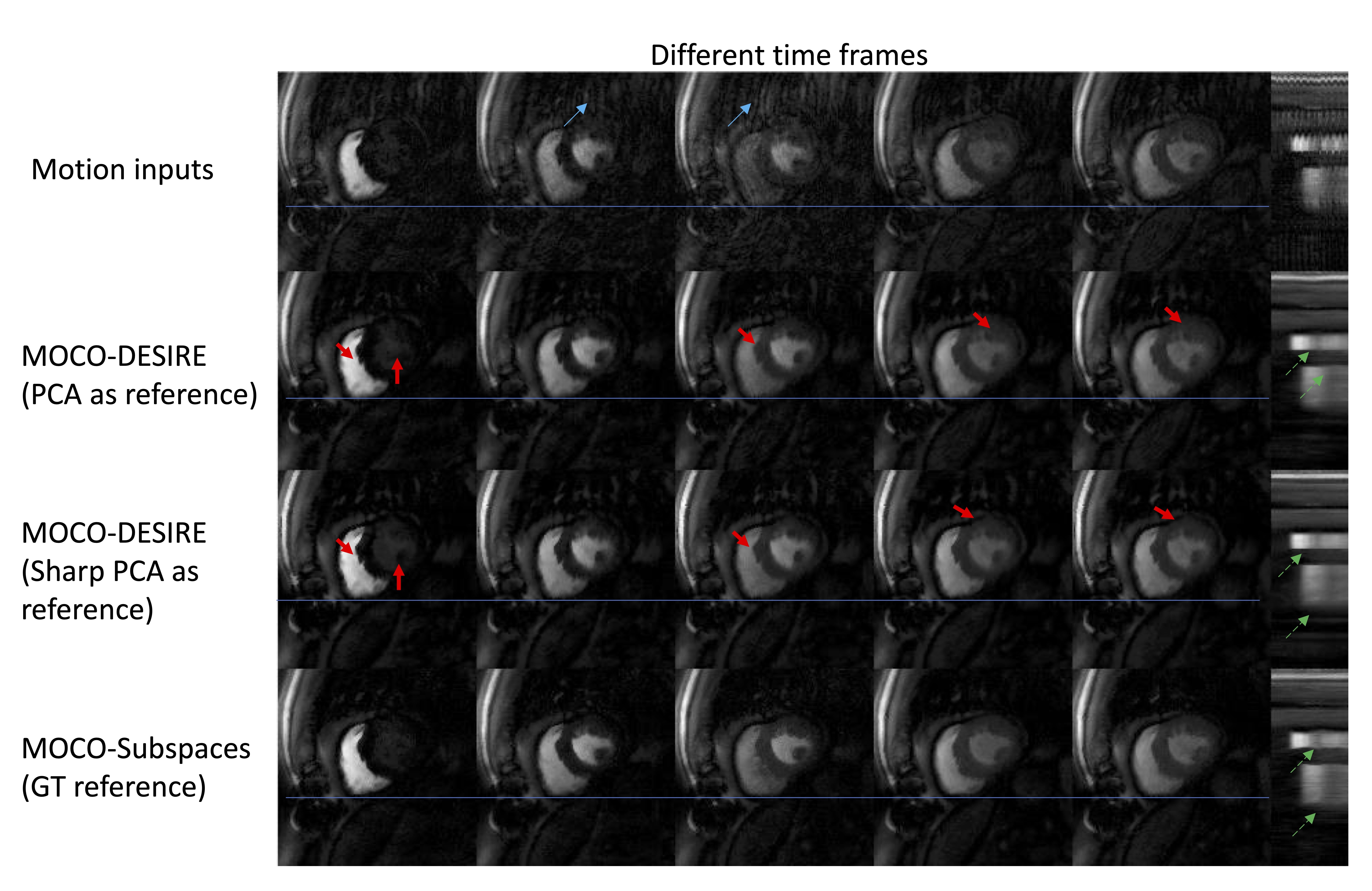
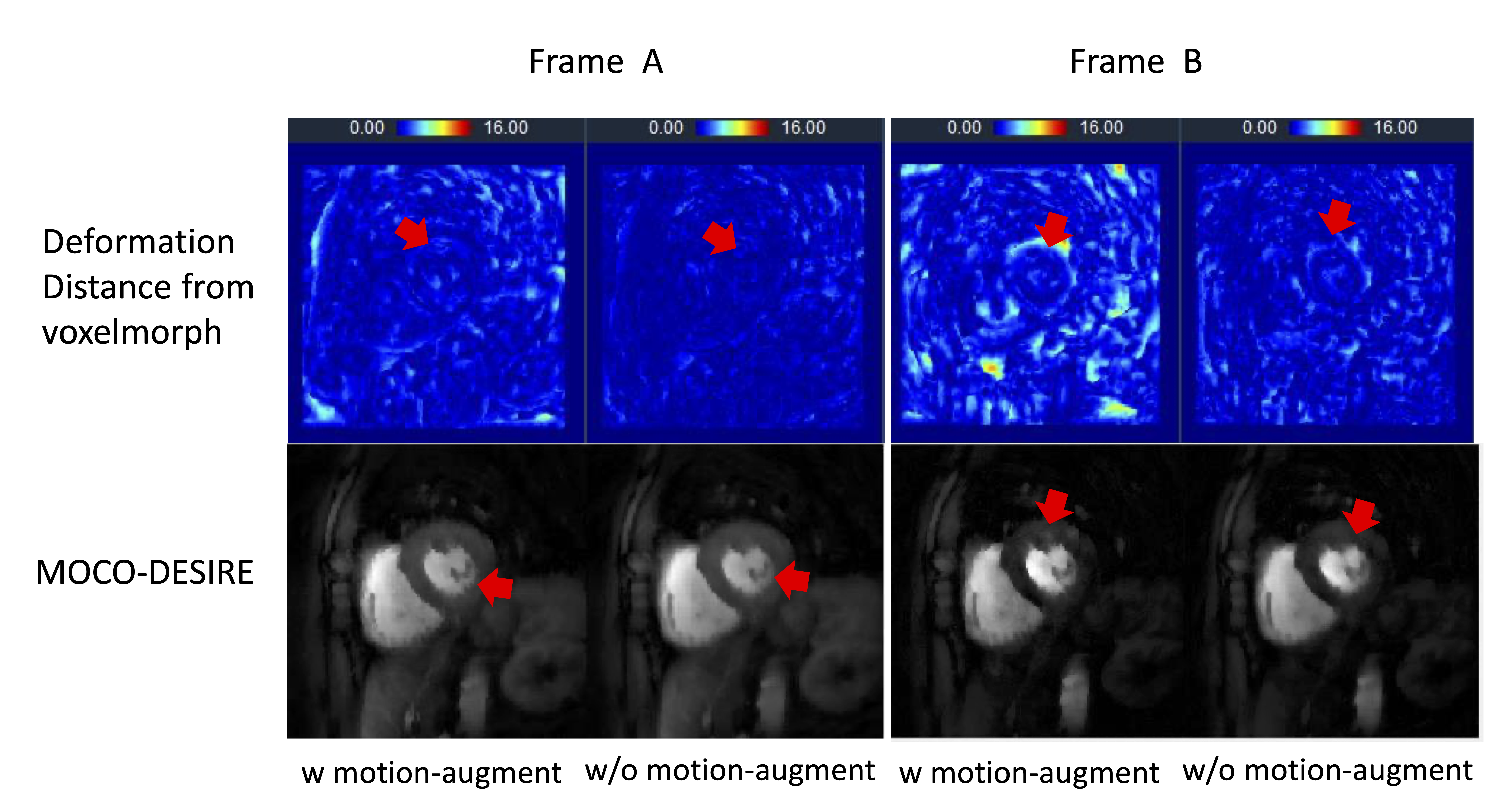 Figure 3. Comparison of free-breathing respiratory images across time frames and corresponding 1D-t profiles using MOCO-DESIRE with conventional PCA and proposed Sharp PCA as VoxelMorph registration references. Blue lines indicate baselines for cross-frame comparison, with 1D-t profiles at the end of each row. Red arrows highlight regions of high sharpness in the Sharp PCA–referenced reconstruction. The blue arrow shows strong artifact suppression, while the green arrow indicates slight residual motion not fully corrected by conventional PCA-guided MOCO-DESIRE or MOCO-subspace, but corrected by proposed Sharp PCA.