Innovations Track

Chenxi Hu
Dr.
School of Biomedical Engineering Shanghai Jiao Tong University, China (People's Republic)
Haiyang Chen, BEng
PhD Candidate
Shanghai Jiao Tong University, China (People's Republic)
Tianshu Zhao
Undergraduate
Shanghai Jiao Tong University, China (People's Republic)
Lan Lan, MD
Professor
Zhongnan Hospital of Wuhan University, China (People's Republic)
Juan Gao
Ms.
School of Biomedical Engineering Shanghai Jiao Tong University, China (People's Republic)
Zhuo Chen
Ms.
School of Biomedical Engineering Shanghai Jiao Tong University, China (People's Republic)
Haibo Xu, MD
Professor
Zhongnan Hospital of Wuhan University, China (People's Republic)
 Figure 2. Comparison of T1 and T2 maps pre- and post-correction. The arrows indicate motion artifacts and blurs. mDM+LR better suppressed the motion-induced errors compared to non-MoCo and pTVreg, agreeing well with the breath-holding reference.
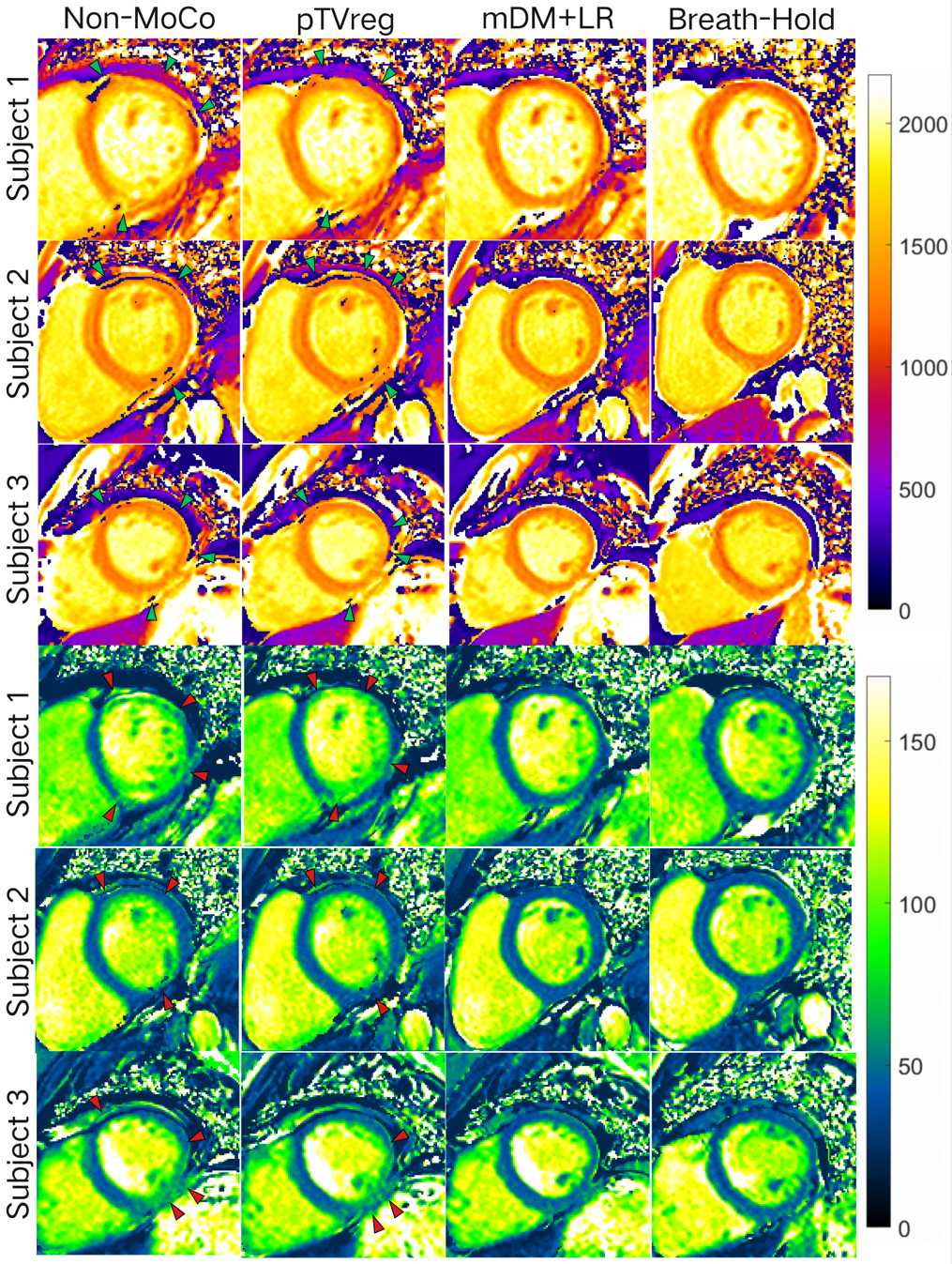 Figure 3. Correlation evaluation of myocardial (A) T1 and (B) T2 values against the breath-holding reference through linear regression and Bland-Altman analyses. The Bland-Altman plots depict the mean differences (black lines) and 95% limits of agreement (red lines). The fitted linear models, Pearson correlation coefficients (r), p-values, and Intraclass Correlation Coefficients (ICC) were labeled. mDM+LR achieved stronger T1/T2 correlation relative to the breath-holding reference than non-MoCo and pTVreg.
.png)