Rapid Fire Session

Raymond Kim, MD
Professor
Duke Cardiovascular Magnetic Resonance Center
Durham, North Carolina, United States
Céleste Chevalier, MD
Postdoctoral fellow
Duke University Medical Center
Durham, North Carolina, United States
Michele Parker, MSc
Statistician / Business Manager
Duke Cardiovascular Magnetic Resonance Center, North Carolina, United States
David C. Wendell, PhD
Senior Research Scientist
Duke University Medical Center
Durham, North Carolina, United States
Han Kim, MD
Associate Professor of Medicine
Duke University Medical Center
Durham, North Carolina, United States
Chen Enn-Ling, PhD
Assistant Professor in Medicine
Duke University Medical Center, United States
 Figure 2. Prevalence of basal septal scar for different grades of SAM. Panel A shows the prevalence of basal septal scar detected using flow-independent dark-blood delayed enhancement imaging (FIDDLE). Panel B shows the prevalence of septal scar detected by regular bright-blood delayed enhancement (DE) CMR. There is a progressive, increasing relationship (p < 0.001) between scar prevalence and SAM grade for both techniques.
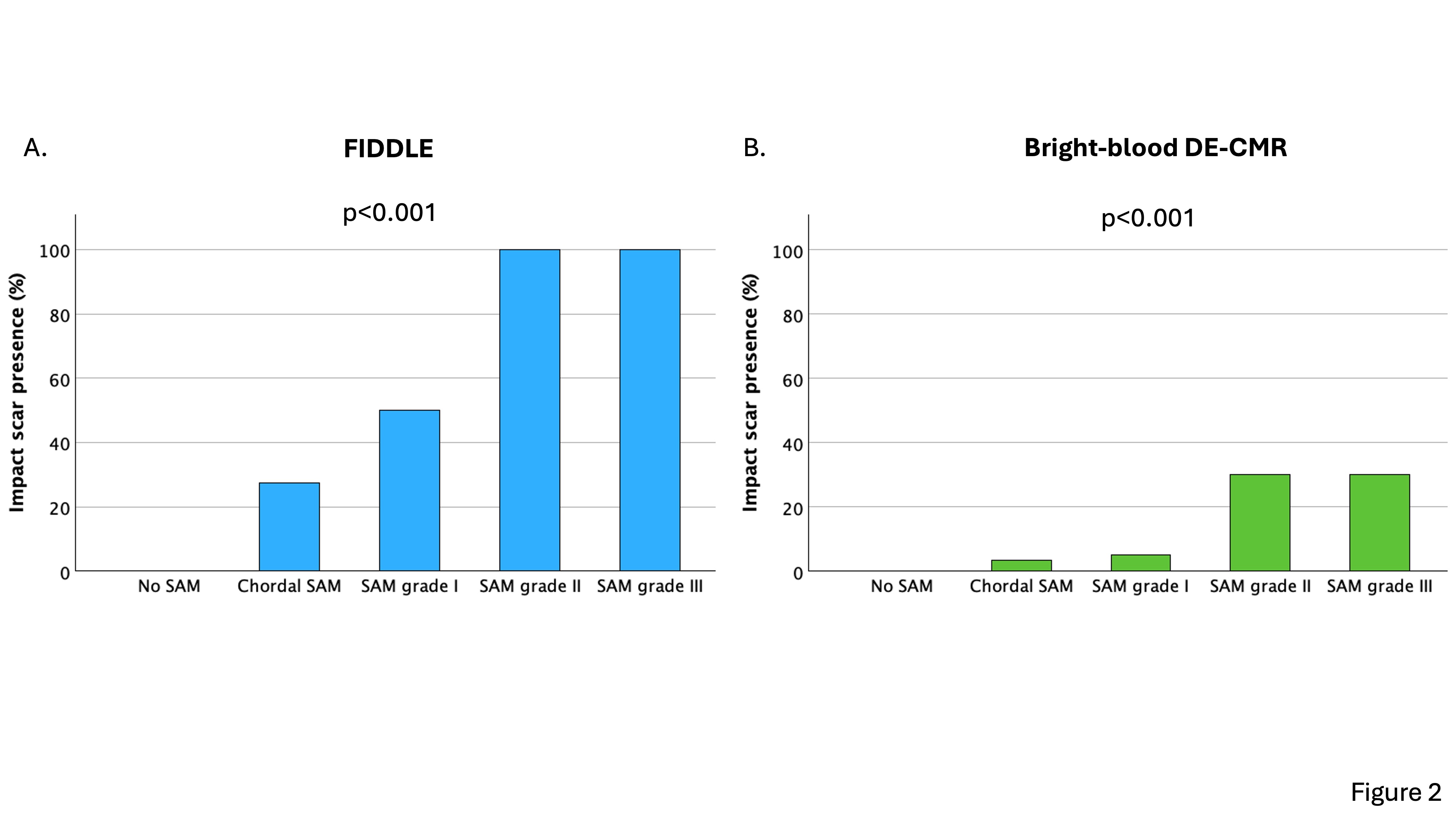 Figure 3. LVOT blood flow characteristics and shape in patients with chordal SAM and SAM grade I. Panel A shows a strong relationship between flow acceleration at the basal septal boundary and basal septal scar (p < 0.001). Panel B shows a moderate association between peak resting LVOT flow velocity and basal septal scar (p=0.05), while Panel C shows no association of basal septal scar presence and basal septal overhang (p=0.57).
.jpg)