Rapid Fire Session
Amro Alsaid, MD, FSCMR
Cardiologist
Baylor Scott & White - The Heart Hospital Plano
Plano, Texas, United States
Mohamad Bader Abo Hajar, MD
Cardiology Research Fellow
Baylor Scott and White The Heart Hospital Plano
Plano, Texas, United States
Cody Dorton, DO
Research Fellow
Baylor Scott & White Research Institute
Plano, Texas, United States
Kyle McCullough, MD
Research Fellow
Baylor Scott & White Research Institute
Plano, Texas, United States
Jennie Hocking, MSc
Research Intern
Baylor Scott & White Research Institute
Plano, Texas, United States
Rahul Gunukula, BSc
Research Intern
Baylor Scott & White Research Institute
Plano, Texas, United States
Prajakta Phatak, MD
cardiologist
Baylor Scott and White The Heart Hospital Plano
Plano, Texas, United States
Janaki Manne, MD
cardiologist
Baylor Scott and White The Heart Hospital Plano
Plano, Texas, United States
J. Michael DiMaio, MD
cardiothoracic surgeon
Baylor Scott and White The Heart Hospital Plano
Plano, Texas, United States
Amro Alsaid, MD, FSCMR
Cardiologist
Baylor Scott & White - The Heart Hospital Plano
Plano, Texas, United States
Amro Alsaid, MD, FSCMR
Cardiologist
Baylor Scott & White - The Heart Hospital Plano
Plano, Texas, United States
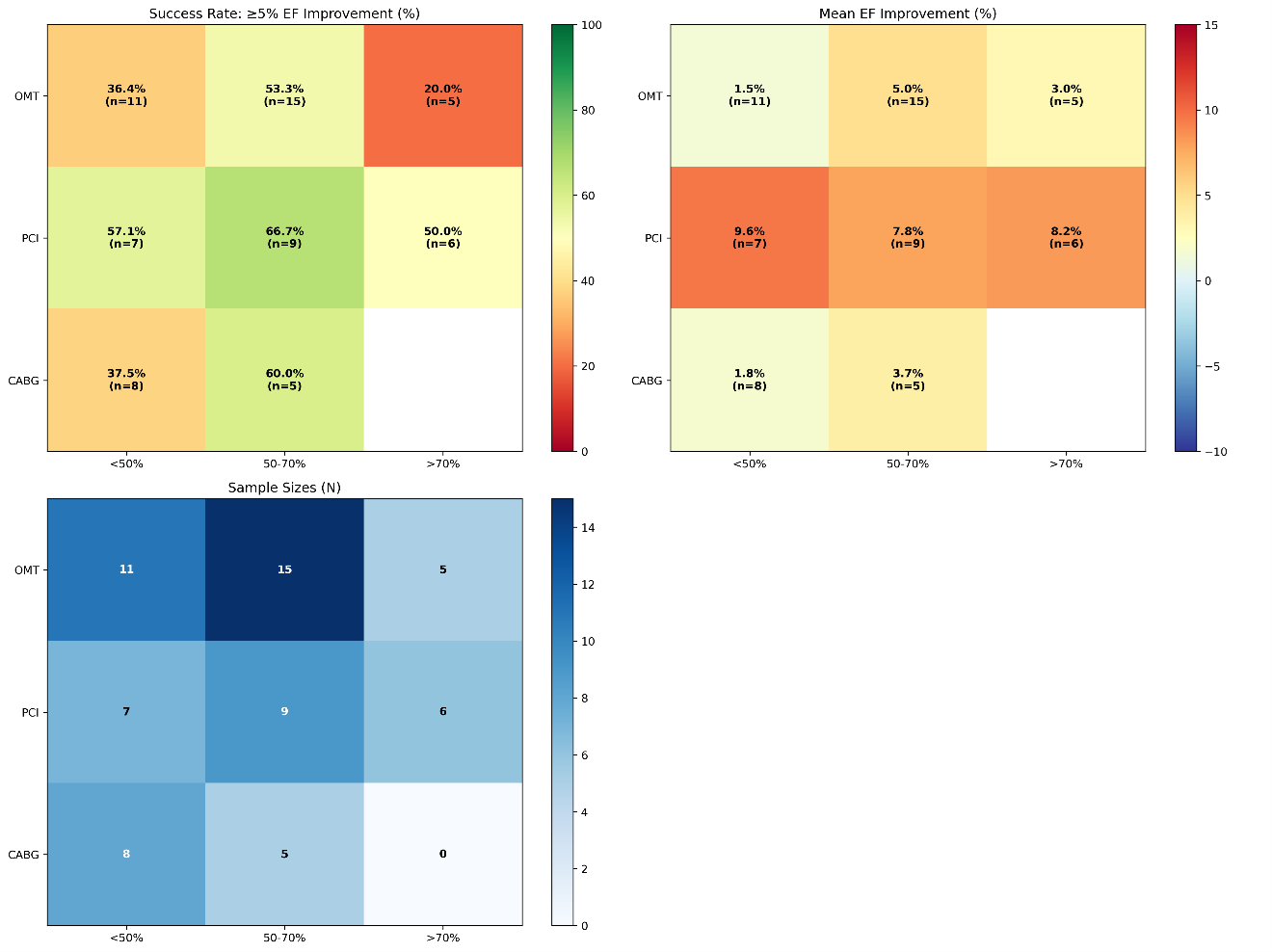
.png) Success rates for achieving ≥5% EF improvement by treatment modality (OMT, PCI, CABG) across three scar categories ( <50%, 50–70%, >70%). Notably, PCI demonstrated benefit even in the >70% scar group, while CABG had diminishing returns beyond the 70% threshold.
Success rates for achieving ≥5% EF improvement by treatment modality (OMT, PCI, CABG) across three scar categories ( <50%, 50–70%, >70%). Notably, PCI demonstrated benefit even in the >70% scar group, while CABG had diminishing returns beyond the 70% threshold.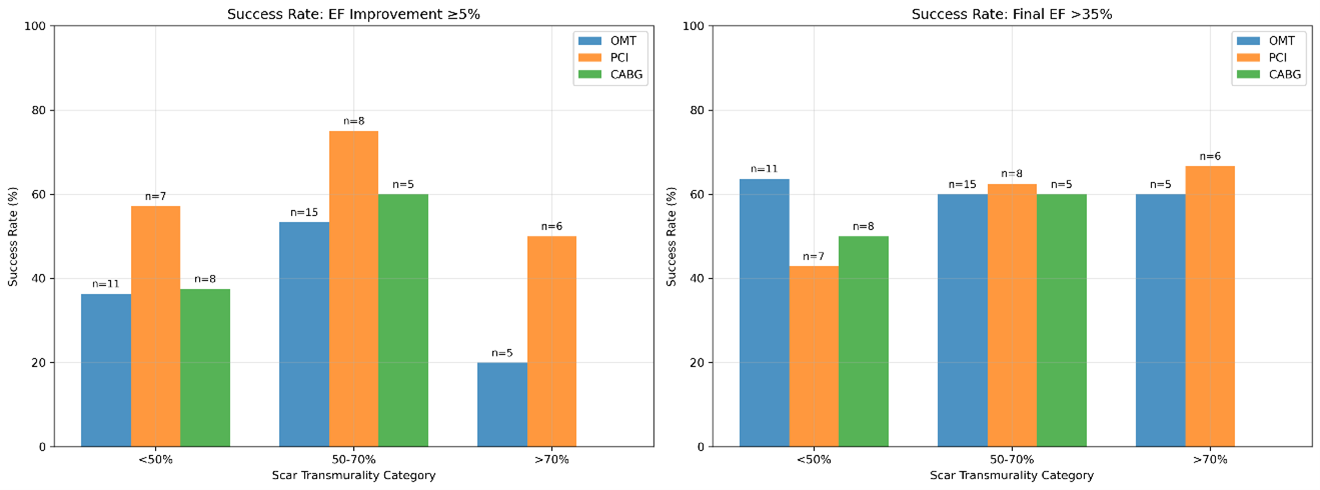 Heatmap showing distribution of patients by treatment modality and scar burden. Most patients undergoing CABG had 50–70% scar, while PCI and OMT spanned a broader range. The graphic underscores the real-world treatment decision variance despite viability thresholds.